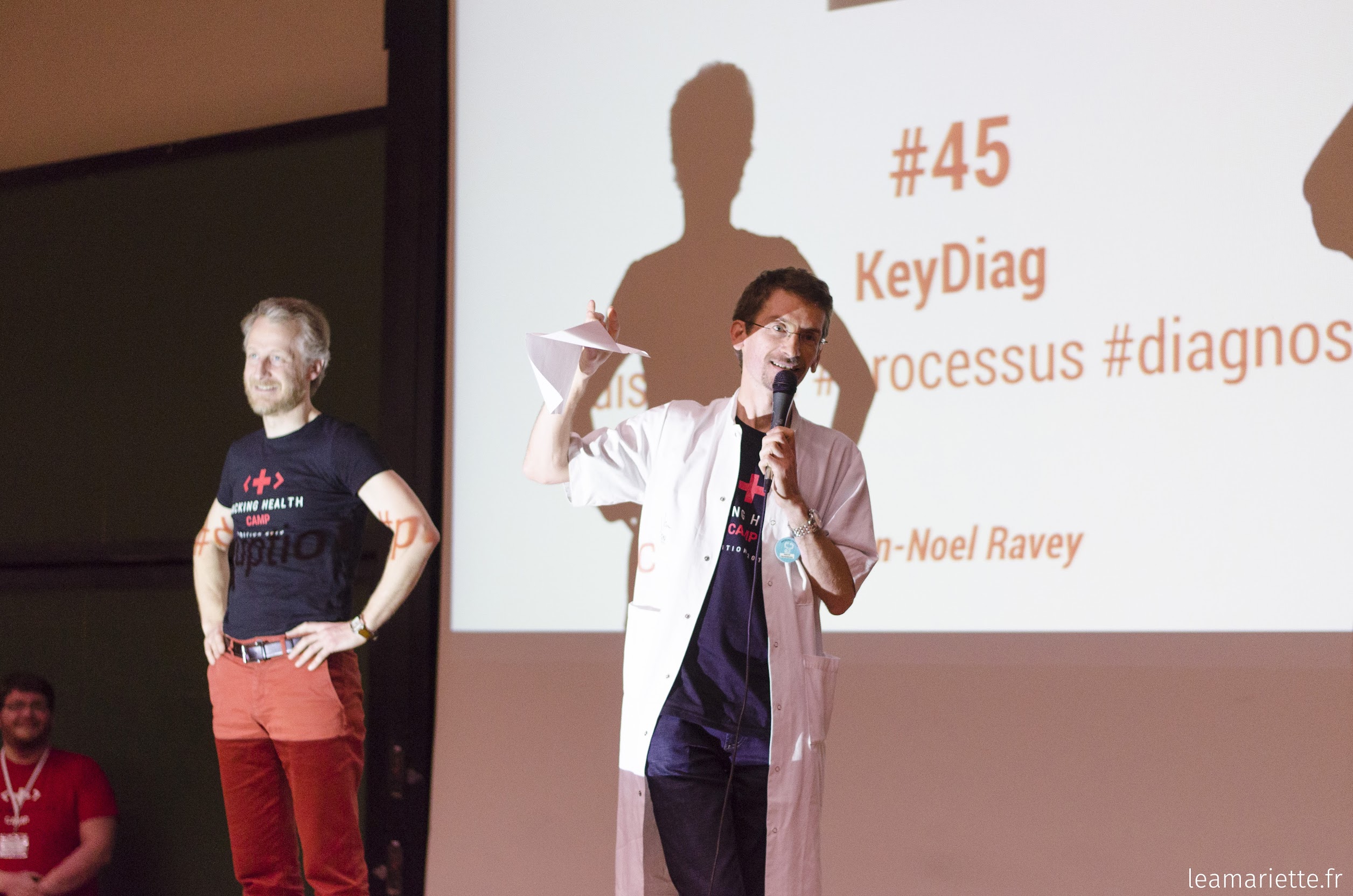
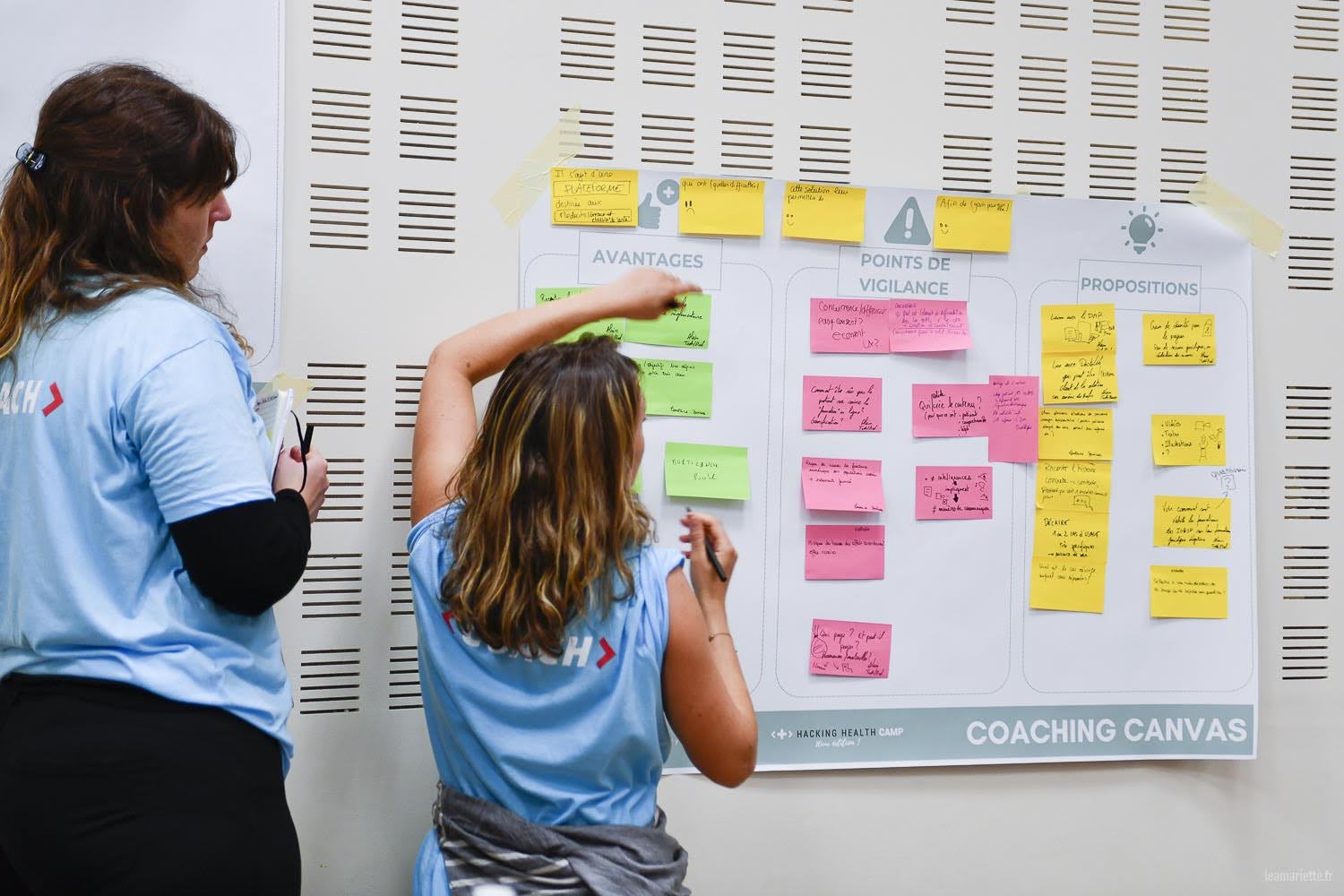
This Hacking Health Camp 2021 feedback report examines the genesis of 11 winning projects led by 12 frontline healthcare innovators (physicians, hospital pharmacists, physiotherapists, orthotists, ocularists, expert patients, data scientists, and hospital CSR leaders). Over a 54-hour interdisciplinary sprint facilitated by Health Factory, each real-world clinical challenge was turned into a functional prototype: GO ONE GAME, HELLO KINÉ, ODYSSÉE, ORTHOMASTER, OXYLIB, Data Breast Cancer Project, Leaf Check, 1000 J, COLORED, STOP BLOC, and ALOUETTE.
Key Takeaways & Metrics
- 12 project leaders and 11 winning teams coached by Health Factory experts during Hacking Health Camp.
- 100% frontline origins: every project stems from a concrete daily pain point experienced by a patient, hospital clinician, private practitioner, or healthcare student.
- Multidisciplinary teams uniting physicians, pharmacists, physiotherapists, patients, AI/Data engineers, UX/3D designers, and legal specialists.
- Full HealthTech spectrum: connected medical devices, predictive oncology, 3D ocular printing, pediatric screening, addiction care, and hospital circular economy.
- Post-hackathon continuity: structured pathways toward startup creation, clinical trials, or hospital deployment.
“In healthcare, a hackathon reveals the human story of women and men who encountered a real problem on the clinical frontline or in their own patient journey, and brought together a multidisciplinary team to turn it into a working prototype over a single weekend.”
The Art of the Health Hackathon: From Frontline Pain Point to Multidisciplinary Team
While hackathons are often associated with software coding marathons, in healthcare they primarily tell the story of the women and men behind each clinical challenge: how did they encounter the problem they are striving to solve? What sparked their commitment, and why did they choose a hackathon to build a prototype?
During the 2021 edition of Hacking Health Camp, we interviewed the 12 challenge owners behind the 11 winning projects. All share a common foundation: direct frontline observation of an unmet clinical or patient need, combined with the conviction that only multidisciplinary collaboration between clinicians, patients, engineers, and designers can solve it rapidly.
Rehabilitation, Patient Autonomy, and Prevention: GO ONE GAME, HELLO KINÉ, ODYSSÉE, and 1000 J
Four winning projects illustrate how lived patient and practitioner experience translates into high-impact connected and digital health solutions:
- GO ONE GAME (led by Youssef Ahmamouti, a hemiplegic patient following an accident and former regional boxing champion, with Cécile Pacoret, Chaib Abrikous, Johan Gilet, Laurent & Béatrice Duris, and Gauthier): an ergonomic, single-handed video game controller restoring gaming accessibility and inclusion for people with motor disabilities.
- HELLO KINÉ — Connected Lumbar Cushion (led by Marion Kraehn, physiotherapist specializing in back care and sports rehab, with Célia Linden, Nykyta Kudrya, Thomas Garello, and AbdelKader Hamadi): a pressure-sensing connected cushion paired with a gamified exercise app to overcome kinesiophobia, restore lower-back mobility at work or home, and track recovery.
- ODYSSÉE (led by Julien Anthouard, addiction harm-reduction specialist at the Ithaque association, with Alexis Grussi, Brave New Media studio, Bastien Giloux, Alexis Galpin, and Théau Leveque): a serious gaming platform built around bio-psycho-social modules to support individuals dealing with addictive behaviors—addressing a field where 80% of needs remain unmet.
- 1000 J (led by digital health and MedTech entrepreneur Jérôme Aubert, with midwife Narguès Klein, Olfa Helal, and Vale Tosi): a web and mobile platform combining validated scientific guidance with 24/7 specialist coaching across a child’s first 1,000 days (from pregnancy to age two).
Oncology, Clinical Data & Pharmacy Safety: Data Breast Cancer Project, Leaf Check, and ORTHOMASTER
Three winning projects tackle medical time loss, drug-herb interactions in oncology, and safe orthopedic dispensing in community pharmacies:
- Data Breast Cancer Project (led by Dr. Clémentine Berkach, medical gynecologist and oncologist at Croix Saint-Simon Hospital in Paris after spending 4 months manually recoding 590 patient records at Saint-Louis AP-HP Hospital, joined by data scientists Razvan Bizoï and Marwen Bouaziz): a secure national registry and real-time statistical meta-analysis platform for breast cancer research (50,000 new cases per year in France).
- Leaf Check (co-led by 6th-year pharmacy student Gaël Cantet and Dr. Bertrand Pourroy, hospital pharmacist heading anticancer drug production at AP-HM Marseille and General Secretary of SFPO, with software engineers Jérémy Villet and Thomas Mahé): a clinical decision-support tool calculating interaction risk levels between phytotherapy and cancer chemotherapy.
- ORTHOMASTER (led by Guillaume Lé, orthotist-prosthetist for 18 years and educator, with pharmacist Nathalie Miquey, Edouard Mangel, Alexandre Stoffel, Emma Lourme, and Inès Chabane): a digital decision tool helping pharmacy teams select the right multi-brand orthopedic device and immediately flag contraindications (such as compression stockings in specific diabetic patients).
Custom Medical Devices, Chronic Care, Pediatric Screening & Hospital CSR: OXYLIB, COLORED, ALOUETTE, and STOP BLOC
The final four winning projects highlight the technological breadth of Hacking Health Camp—from medical IoT and 3D printing to hospital circular economy:
- OXYLIB (led by Loïc Mastio, AI & Big Data Master’s student at Epitech Strasbourg and pharma Data Scientist, inspired by the patient association “Le souffle en marche”, with Dr. Dominique Bourgouin, Sofian Delalay, Melisa Yildirim, Pierre-Hugues Pinçon, Quentin Belle, and Luca Donati): a Bluetooth unit mounted on oxygen cylinders paired with a smartwatch to automatically regulate oxygen flow for COPD patients during physical effort.
- COLORED (co-led by ocularist Florian Eckert and 3D digital sculptor Clément Kam, with Nicolas Bouvier in Data/AI and Camille Obrecht in UX/UI): a CAD/CAM and custom full-color 3D iris printing system that standardizes chromatic precision and saves critical manufacturing time for ocular prostheses.
- ALOUETTE (led by Dr. Violaine Mehault-Holmes, general practitioner trained in pediatric visual screening and supported by the CPAM innovation hub, with Epitech students Clément Bernat, Ramsford Sheamang, Jonathan Bantzhaffen, and Jérémy Chenet): a collaborative parent-physician mobile app for early pediatric sensory screening, combining red-reflex pupillary photography and acoustic hearing tests.
- STOP BLOC (led by Thomas Guillou, CSR project manager at private hospital group ELSAN, with Gaël Paugam, Jean-Michel Thirion, and Adan): a digital identification and traceability solution to recover and reuse hospital cold packs (eutectic plates) and insulated medical packaging—tackling the 5 million insulated boxes and 20 million cold packs used annually in France.
Frequently Asked Questions
Who are the challenge owners in a healthcare hackathon like Hacking Health Camp?
As demonstrated by the 2021 feedback report, challenge owners come directly from the frontline: hospital and general practitioners, pharmacists, physiotherapists, orthotists, ocularists, social workers, hospital CSR managers, healthcare students, and expert patients who have personally experienced a medical challenge.
What types of prototypes emerge from the 54-hour Hacking Health Camp sprint?
The 11 winning projects from 2021 span the entire HealthTech landscape: connected medical devices (OXYLIB, HELLO KINÉ), inclusive hardware (GO ONE GAME), clinical and pharmacy decision-support software (Leaf Check, ORTHOMASTER), oncology data registries (Data Breast Cancer Project), 3D medical printing (COLORED), early screening and prevention apps (ALOUETTE, 1000 J, ODYSSÉE), and sustainable hospital logistics (STOP BLOC).